Doodle Line Practice: Warm-Ups for Steadier, Cleaner Lines
A five-minute warm-up page of lines, waves, loops, zigzags, spirals and circles, plus the small habits that turn scratchy, hesitant strokes into clean, confident ones.
Doodle at a glance
What you need
- Any pen you plan to doodle with
- A blank or dot-grid page
- A flat surface with room to move your forearm
Shaky, scratchy lines are rarely a sign that you cannot draw. They usually mean your hand is moving slowly and carefully, a few millimeters at a time. A little doodle line practice before you start changes that faster than you might expect.
What follows is a five-minute warm-up page and a handful of small habits: how fast to move, which joint to move from, where to point the paper and how to keep ink from pooling. None of it aims at perfect lines. The aim is lines that look like you meant them.
The Five-Minute Warm-Up Page
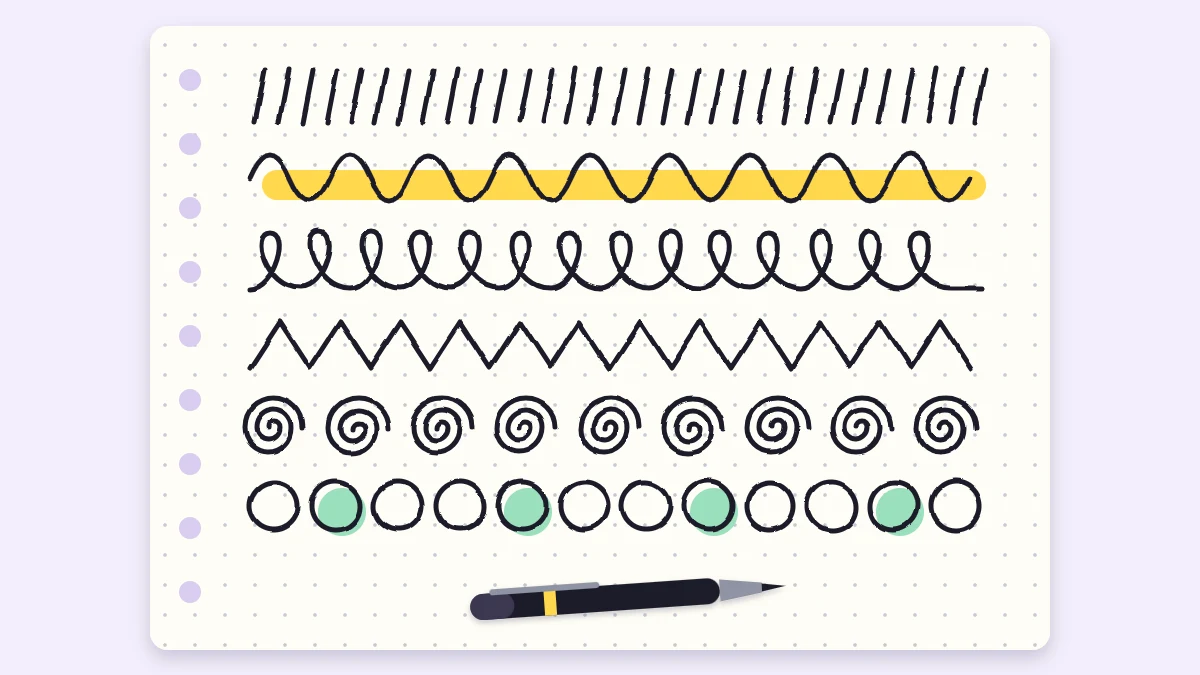
Take a blank or dot-grid page and fill it with six kinds of marks, a row or two of each. Work across the page and keep the pen moving at an easy, steady pace.
- Parallel lines. Draw ten straight lines about as long as your finger, side by side, with even gaps. Then draw ten more, shorter and closer together.
- Waves. Draw one line that rises and falls in smooth, equal humps from one side of the page to the other, without lifting the pen.
- Loops. Draw a chain of joined loops, like a row of handwritten letter e shapes. Try to keep every loop the same height.
- Zigzags. Draw a row of sharp, equal points, up and down. Pause for an instant at each point so the corners stay crisp.
- Spirals. Start with a dot and wind outward in three or four turns, keeping the gap between the rings even. Then draw one winding the other way.
- Circles. Draw a row of small circles, each in a single stroke. Aim to finish each one exactly where it started.
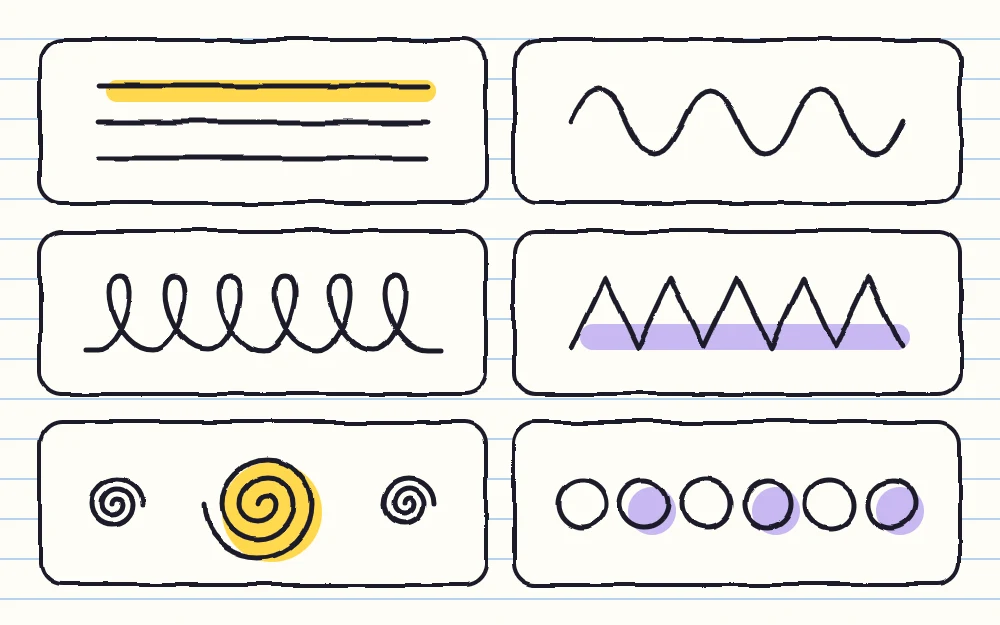
The first row will look rough. By the last row your hand has usually found its pace, and that is the moment to start doodling.
One Quick Stroke Beats Ten Short Ones
The most common cause of a messy line is building it out of many tiny overlapping strokes, feeling your way along. The result looks hairy, and it looks unsure.
A single stroke drawn at moderate speed is smoother, even when it ends up a little off course. Your hand cannot tremble much when it is already moving. Try it both ways:
- Draw a line the length of your thumb using a dozen short sketchy dashes.
- Next to it, look at where the line should end, then draw it in one movement.
- Do the same with a circle: once with many small arcs, once in a single sweep.
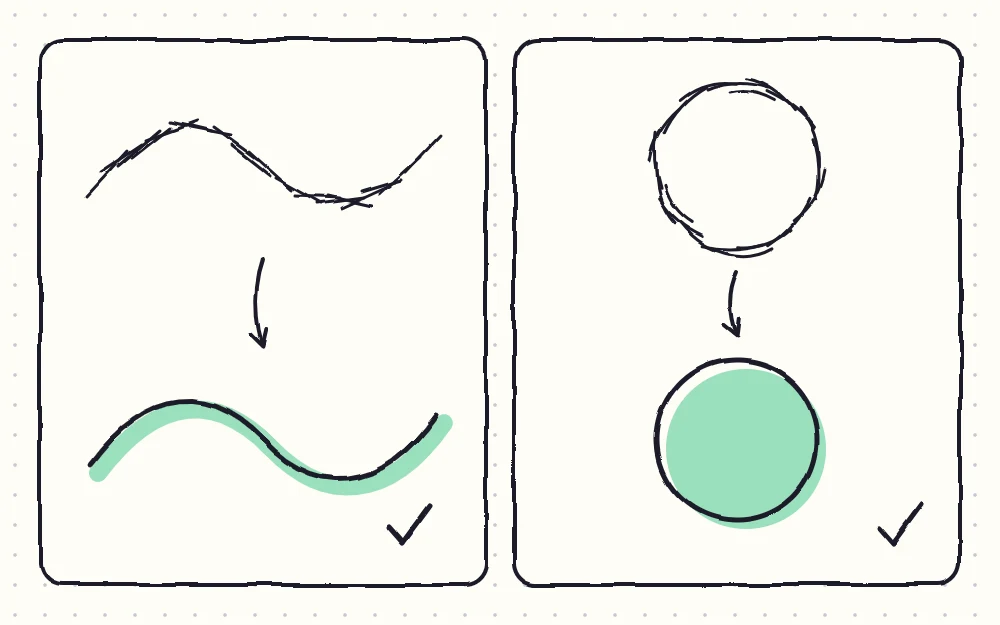
If a one-stroke line misses, leave it and draw the next doodle. Going back over it to “fix” it brings the hairy look straight back.
Wrist for Small Marks, Elbow for Long Lines
Your hand has a natural reach. With the side of your palm resting on the paper, your fingers and wrist can comfortably cover a couple of centimeters. That is perfect for petals, tiny stars, faces and anything coin-sized.
Past that reach, a wrist-only line starts to curve, because the wrist swings like a hinge. For a long straight line, such as a divider across a page, lock your wrist, let your hand glide lightly over the paper and move your whole forearm from the elbow. It feels odd at first and looks straighter almost at once.
Turn the Page, Pull the Line Toward You
Most people have one direction in which lines come out best. For many it is a pull: starting away from the body and drawing the pen back toward it. Pushed lines tend to wobble or dig into the paper.
So do not twist your hand into an awkward angle to draw a line going the “wrong” way. Turn the notebook instead. Rotate it until the stroke you need lines up with your comfortable direction, draw it, and rotate back. It is quicker than it sounds, and it works for curves too: the easy arc for your hand is the one to use every time.
Tip
For a straight line between two points, mark a tiny dot at each end, look at the far dot and draw toward it. Watching the target, not the pen tip, keeps the line on course.
Keep the Pressure Even
Blobs at the start and end of a line come from the pen sitting still on the paper while ink keeps flowing. Two habits get rid of most of them:
- Land moving. Start the motion just before the tip touches down, like a plane meeting a runway.
- Lift moving. Raise the pen as the stroke ends instead of stopping and then lifting.
Hold the pen loosely and press only as hard as you need for a solid line. A tight grip makes strokes jerky and tires your hand. How much pressure is enough depends on the pen, which the guide to pens and paper for doodling explains type by type.
Close Your Shapes Neatly
A circle with a gap or an overshoot at the join draws the eye to it. To close a shape cleanly, slow down slightly for the last quarter of the stroke and aim for the starting point as if it were a target.
For squares and triangles, draw each side as its own stroke and let the corners just touch. A tiny overlap at a corner looks fine. A gap looks unfinished. Practice by drawing a row of small boxes and a row of triangles, which is also a good lead-in to building doodles from basic shapes.
A Little Wobble Is Fine
None of this is meant to make your lines look ruled. A doodle with perfectly straight edges looks stiff. A slight waver, a corner that is a little soft or a circle that is a little egg-shaped all read as hand-drawn, and that is the charm of the style.
The difference to aim for is between a line that wobbles and a line that hesitates. The first is one confident stroke with character. The second is a pile of short strokes.
When you want more than a warm-up page, repeating lines turn naturally into designs. Stripes, chevrons and grids are simply practice rows arranged with care, and geometric doodle patterns gives you ten of them to fill a box or a section of a page.
Frequently asked questions
Why are my doodle lines shaky?
Usually because the pen is moving too slowly or the line is being built from many short strokes. Draw each line in one movement at a moderate speed, look at where it should end, and hold the pen loosely. A short warm-up page before you start also helps your hand settle.
How long should I warm up before doodling?
About five minutes is plenty. One or two rows each of straight lines, waves, loops, zigzags, spirals and circles is enough to find a steady pace. If you are short on time, a single row of circles and a row of parallel lines still makes a difference.
How do I draw a straight line without a ruler?
Mark a small dot where the line starts and another where it ends. Turn the page so you can pull the pen toward you, keep your wrist still and move your whole forearm from the elbow while looking at the far dot. A slight wobble is normal and suits the style.