How to Make Doodles Cute: Faces, Proportions and Tiny Details
The short recipe behind soft, friendly doodles: rounder and shorter shapes, tiny features on a big body, a face set low and wide, blush marks and a highlight, plus six simple expressions and five objects turned into little characters.
Two people can draw the same mug with the same pen, and one comes out looking like a diagram while the other looks like it wants to be your friend. The difference is not skill. It is a handful of small choices about shape, size and what gets left off.
If you have wondered how to make doodles cute without learning to draw “properly”, the good news is that the recipe is short. Rounder shapes, a low little face and a couple of tiny details do nearly all of the work, and each one is a change you can make on your very next doodle.
Go rounder and shorter
Stiff doodles tend to be tall, thin and sharp-cornered. Soft ones are squat and plump. Before adding anything, change the outline itself:
- Squash it. Draw the object shorter and wider than it really is. A mug that is nearly as wide as it is tall looks friendlier than a tall narrow one.
- Round every corner. Wherever two straight lines would meet at a point, swing around the turn in a small curve instead. A square becomes a soft pillow shape.
- Bulge the sides. Let straight edges bow outward a little, as if the object were slightly inflated.
- Shrink the sticking-out parts. Handles, stems, arms and legs get short and stubby.
Try it with a star. Draw a regular five-point star, then draw it again with each tip rounded off like a fingertip and the inner corners softened into curves. The second one already looks cuter, and it has no face yet.
If seeing objects as a few simple forms is new to you, start with the guide to building doodles from lines, circles and boxes.
Big body, tiny features
Size contrast is the second ingredient. A large, simple shape with very small features on it reads as soft and young.
So keep eyes as dots, not circles. Keep the mouth shorter than the gap between the eyes. If the doodle has arms or feet, draw them as tiny nubs or short single lines. When a doodle is not working, make its features smaller before you add more of them.
Set the face low and wide
Where the face goes matters more than how it is drawn. The basic face is two dots and one small curve, and the placement rules are simple:
- Imagine a line across the shape, a little below the middle. Both eyes sit on that line.
- Put the eyes far apart, closer to the sides of the shape than to each other.
- Draw the mouth as a tiny curve like a shallow letter U, centered between the eyes and level with them or just a hair lower.
That leaves a big empty forehead above the face, which is exactly what you want. Faces placed high and close together look alert or worried; low and wide looks calm and sweet.
Six expressions from dots and curves
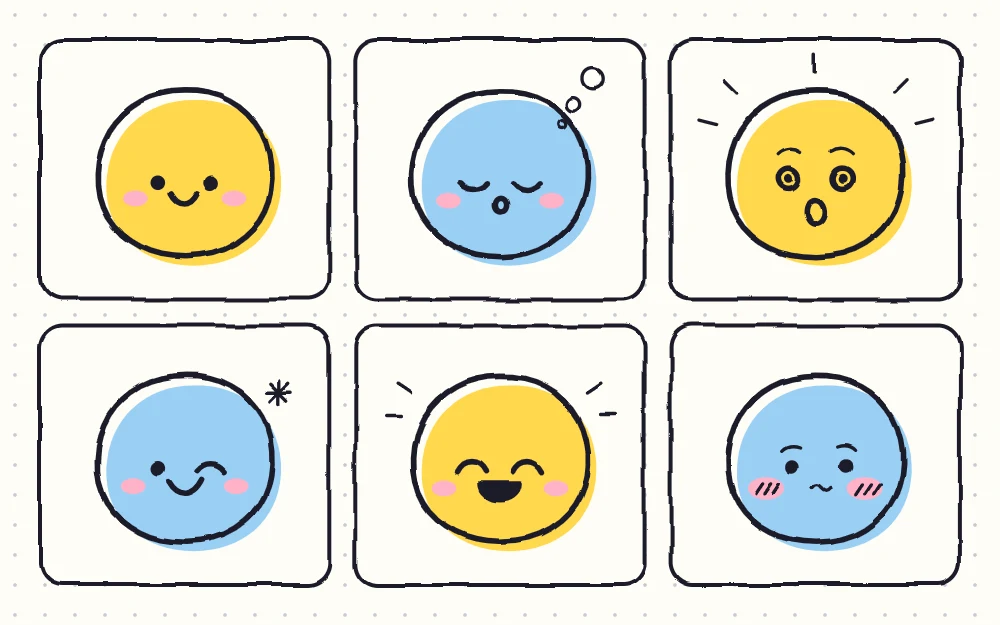
Once the placement feels natural, you can change the mood by swapping a mark or two. Draw a row of six round blobs and give each a different face.
- Smiling: two dots and a small U-shaped curve.
- Sleepy: replace each dot with a short curve that sags downward like a tiny smile, and make the mouth a very small circle or a flat dash.
- Surprised: two dots and a small open circle for the mouth. Two short dashes above the eyes, as raised brows, push it further.
- Winking: one dot, and one short arch curving upward where the other eye would be. Keep the small U mouth.
- Laughing: both eyes become upward arches, like two little hills, and the mouth becomes a wide D shape lying on its flat side, open at the top.
- Shy: two dots, a very short mouth nudged slightly to one side, and extra blush marks under each eye.
Blush marks and tiny highlights
Two finishing touches go a long way, and both take a second.
Blush marks sit just below and outside each eye. Draw them as a small oval, two or three short slanted dashes, or a dab of pink from a highlighter or marker. Keep them lower than the eyes and well out toward the edge of the shape.
Highlights suggest shine. The simplest is a short curved line near the upper left edge of the body, following the outline.
Watch out
If you add pink over pen lines, wait a minute first. Gel and felt-tip ink can smudge until dry, and a gray streak across the cheeks is hard to hide.
Leave things out
Each extra line makes a drawing more accurate and less charming, so edit hard. A simple face has no nose, no eyelashes and no teeth. A cactus needs five or six spines, not fifty.
A useful test: once the doodle is recognizable, stop, and add only one more thing. That one thing is usually the blush or the highlight.
Turn any object into a little character
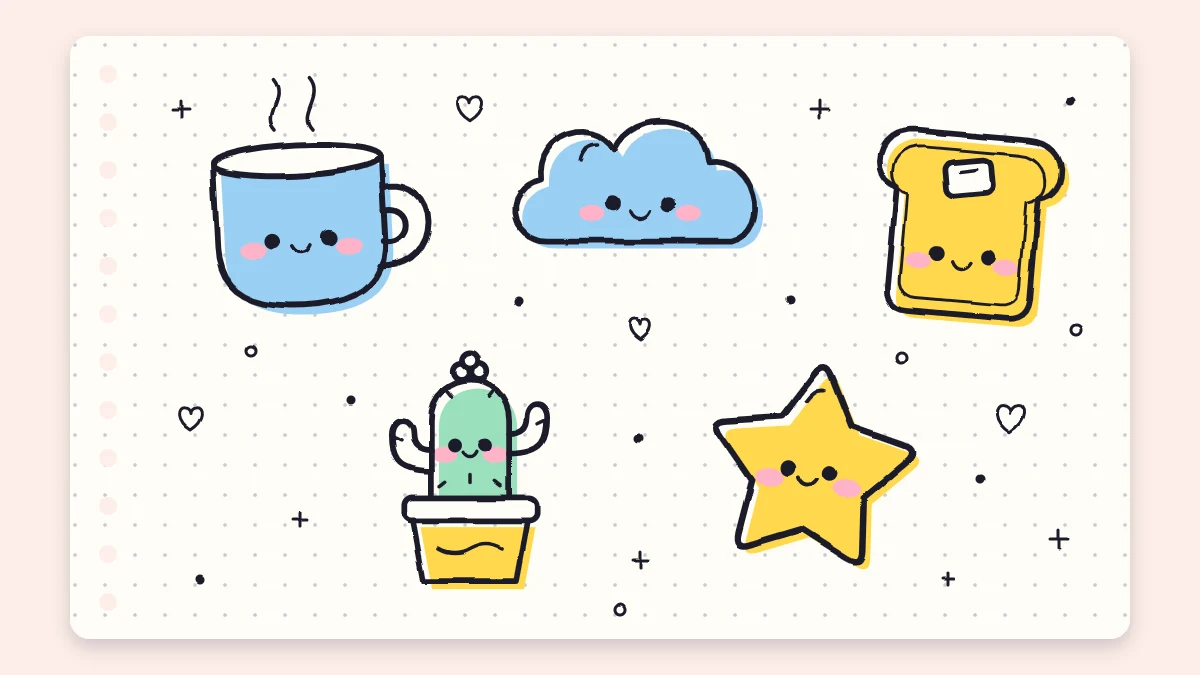
Here is the whole recipe applied to five everyday things. In each case, draw the soft outline first, then the low, wide face, then blush.
- Mug: a squat rounded rectangle with a small C-shaped handle. Put the face on the lower half and two short steam curls above the rim.
- Cloud: a flat base line with three or four puffy bumps above it, the middle one tallest. The face sits just above the base.
- Toast: a rounded square with two soft bumps along the top, and a second outline just inside for the crust. Face in the lower middle.
- Cactus: a short, fat upright oval with one stubby arm on each side, sitting in a small pot drawn as a trapezoid. Add a few short dashes for spines and keep them away from the face.
- Star: the rounded-tip star from earlier, with the face low in the center so the top point acts as the forehead.
The same approach works on creatures and snacks. For animals, the cute animal doodles made from simple shapes walk through a dozen designs, and the snack and treat doodles give you donuts, cupcakes and more to add faces to.
Keep the style your own
It is tempting to copy a well-known character from a show, a game or a product, but inventing your own is more fun. The ingredients are free to everyone: round shapes, dot eyes, a small mouth, blush.
Pick one or two habits and repeat them on everything you draw. Maybe your blush is always three dashes, or your mouths sit a little off to one side, or every character gets one tiny leaf on top. Small repeated choices like these make a page of doodles look like it came from one hand.
Frequently asked questions
Why do my doodle faces look creepy instead of cute?
The features are usually too large, too close together or too high on the shape. Shrink the eyes to plain dots, move them apart toward the sides, and slide the whole face below the middle. Then shorten the mouth so it is narrower than the gap between the eyes.
Do cute doodles need color?
No. Shape and face placement do most of the work, so a plain black outline is enough. If you want one accent color, a small dab of pink for blush marks is the most effective place to put it. Let pen lines dry before coloring over them.
Can I add a face to any doodle?
Almost any object with a clear, simple body works: cups, clouds, fruit, plants, stars, books. Soften the outline first, then place two dots and a small curve low on the widest part. Very thin objects, such as a pencil, need a slightly fatter outline to make room for the face.