Small Flower Doodles: 12 Tiny Blooms for Margins and Corners
Twelve tiny flowers you can draw in a few strokes each, from a five-petal bloom to a dandelion puff, with simple ways to group them in corners, margins and gaps.
Some gaps on a page are too small for a real drawing: the end of a line, the corner beside a date, the space under a heading. That is exactly where small flower doodles belong. Each one is a handful of strokes, finished before the ink of the first petal has dried.
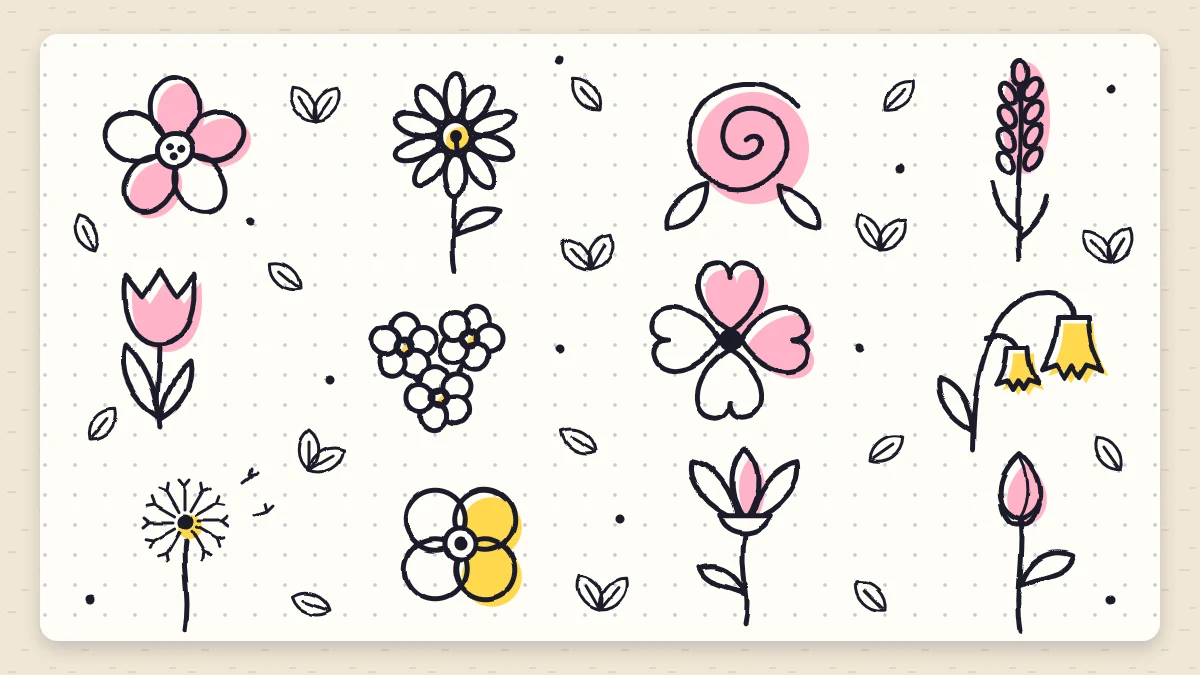
Below are twelve tiny blooms, sorted by how they are built, followed by a few ways to group them so they look planted on purpose. For bigger flowers with full stems, the step-by-step guide on how to doodle a daisy, tulip and sunflower picks up where this one stops.
Draw Them at Fingernail Size
Aim for a flower no bigger than the nail on your little finger. At that size your pen tip does a lot of the work: a petal is one small loop, a center is one dot, and there is no room for mistakes to show.
A fine tip of around 0.3 to 0.5 mm keeps the petals from closing up into blobs. Move only your fingers, and do not go back over a line. One crooked petal looks natural.
Six Round Flowers Seen From the Front
These all start from a center and work outward.
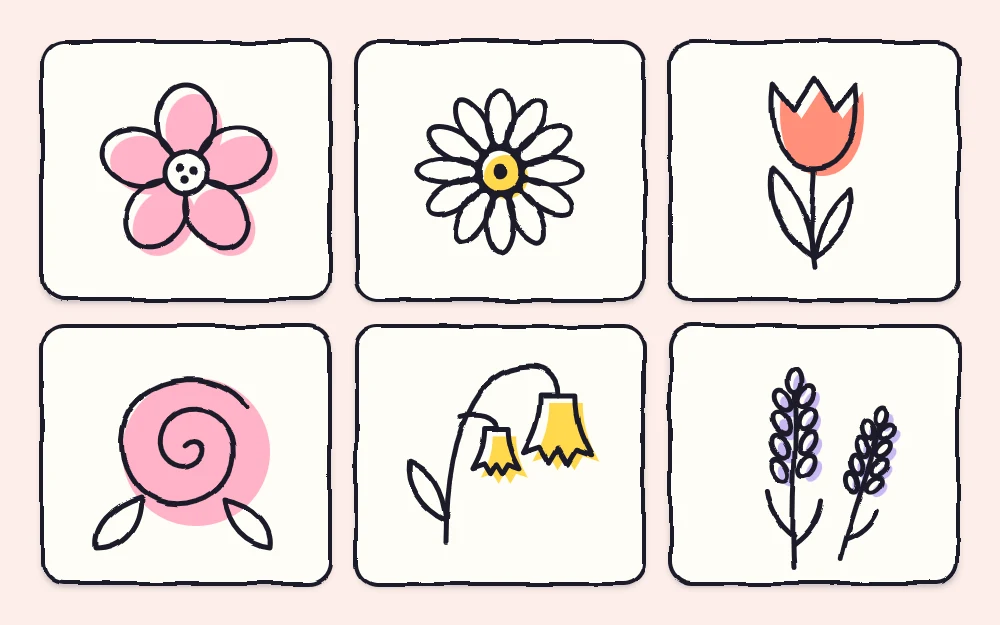
- Five-petal flower: draw a small dot or circle. Add five round loops around it, each starting and ending on the center. Draw the top petal first, then the two lower ones, then fill the two side gaps.
- Four-petal flower: draw a dot, then four wide loops at the top, bottom, left and right, like a plus sign made of petals. Add a short dash between each pair of petals for a little extra detail.
- Daisy with a dot center: draw a solid dot. Surround it with eight to ten thin, narrow loops, about twice as long as they are wide. Place four at the clock points first so the rest stay even.
- Spiral rose: start with a tight curl in the middle and keep spiraling outward for two or three turns, letting the line wobble. Close the spiral, then add one small curved bump on the outside edge for a loose petal.
- Forget-me-not cluster: draw three or four very small five-petal flowers so close together that their petals touch. Use an open circle for each center. Add two or three loose dots beside the cluster as unopened buds.
- Heart-petal flower: draw a small circle. Around it, draw four or five tiny hearts with their points touching the center. The notch at the top of each heart gives the petals a soft dip.
Four Flowers Seen From the Side
Side views need a stem, even a very short one, because the stem tells the eye which way is up.
- Tulip cup: draw a small U. Close the top with a zigzag of three points, the middle one slightly taller. Drop a short curved line from the bottom of the U for the stem.
- Bell flower: draw a stem that curves over at the top like a walking cane. From its tip, hang a small bell: two lines that flare outward as they go down, joined by a wavy edge with three small scallops. Add a dot hanging just below the edge.
- Bud on a stem: draw a straight or gently curved stem. At the top, draw a small teardrop with the point facing up. Add two tiny curved lines hugging the base of the teardrop where it meets the stem.
- Side-view flower: draw a short stem, then a small half circle sitting on top of it with the flat side up, like a bowl. From the flat edge, draw three or four petal loops fanning upward and outward.
Two Sprigs and Puffs
These two have no petals, so they break up a row of round flowers.
- Lavender sprig: draw a thin, slightly curved stem about as tall as two lines of writing. Starting halfway up, add pairs of tiny teardrops or short dashes on both sides, angled upward, getting smaller toward the tip. End with a single teardrop on top.
- Dandelion puff: draw a stem with a small dot at the top. From the dot, flick ten to twelve short, straight lines outward in all directions, like the spokes of a wheel. Put a tiny dot or a small V at the end of each line. For a blown puff, leave one side empty and let three loose seeds drift away.
Add Two Leaves and Stop
A tiny flower rarely needs more than two leaves. Draw a short stem, then one small pointed leaf on each side, set at slightly different heights so they do not look like wings. On the round flowers with no stem, tuck one leaf under the bloom so that only its tip pokes out.
If you want other shapes, such as round, heart-shaped or fern-like leaves, the article on easy leaf doodles covers twelve of them.
Tip
Touch just one or two petals with an accent color and leave the rest empty. On a flower this small, a single dab of highlighter reads as a fully colored bloom.
Group in Threes and Mix the Sizes
One tiny flower alone can look lost. Three together look like a plan.
- Big, medium, tiny: draw one flower at full fingernail size, one at about two thirds and one that is hardly more than a dot with petals.
- Triangle, not a row: place the three so they form a loose triangle. A straight line of flowers looks stiff.
- Two kinds at most: pair a round flower with a sprig, for example two five-petal flowers and one lavender stem.
- Filler last: finish with three or four dots or a tiny leaf in the gaps between them.
Where Tiny Flowers Work on a Page
Because they are so small, these flowers fit almost anywhere without crowding the writing.
- Corners: a group of three in the top or bottom corner, with the biggest flower closest to the corner itself.
- Margins: a single lavender sprig or bud beside the first line of each new section.
- Bullets: a four-petal flower in place of a plain dot at the start of a list item.
- Ends of lines: a spiral rose after the last word of a heading.
- Section breaks: one flower in the middle of a plain line, which is one of the simplest doodle dividers there is.
For a whole page, choose one flower from the twelve as that page’s motif and repeat it. A page with a daisy in the header, the corner and the bullets feels calmer than a page with twelve different blooms. You will find more ways to place a motif in these notebook doodle ideas.
Frequently asked questions
What is the simplest small flower to doodle?
The five-petal flower is the simplest. Draw a dot, then five round loops around it that each begin and end on the dot. It takes a few seconds, works at almost any size, and still looks like a flower when the petals come out uneven.
How small can a flower doodle be?
With a fine pen tip you can go down to about the size of a lentil. Below that, petals tend to fill in with ink. At the smallest sizes, switch to the simplest shapes: a dot with four or five tiny loops, or a stem with a teardrop bud.
Which pen is best for tiny flowers?
A fineliner or gel pen with a tip of around 0.3 to 0.5 mm suits tiny petals, because a thin line leaves open space inside each loop. Thicker tips work better for larger flowers. Gel ink can smudge until dry, so let it sit before adding any color.