Cat and Dog Doodles: Simple Pets to Draw in a Few Lines
A sitting cat and a dog face drawn stroke by stroke, five more easy poses, and simple ways to change ears, tails and markings so the doodle suggests your own pet.
Doodle at a glance
What you need
- Black fineliner or gel pen
- Pencil and eraser for guide lines
- One highlighter for markings
- Any notebook page
A cat asleep on the windowsill or a dog waiting by the door is about the best free model a doodler can ask for. You do not need to capture the real animal, though. Cat and dog doodles work with a round head, a soft body and three or four details in the right places.
Here are one cat and one dog in full, stroke by stroke, then a handful of poses and some ways to nudge the doodle toward your own pet.
What Makes It a Cat or a Dog
Both animals begin with the same rounded head. Three features decide which one you end up with.
| Feature | Cat | Dog |
|---|---|---|
| Ears | Two upright triangles | Floppy U shapes, or wider pointed ears |
| Face | Tiny nose, flat face, whiskers | Rounder muzzle with a bigger nose |
| Tail | Long, thin and curved | Shorter, often pointing up |
Get those three right and the rest can be as loose as you like. For other small creatures made the same way, see the set of cute animal doodles.
A Sitting Cat in Four Stages
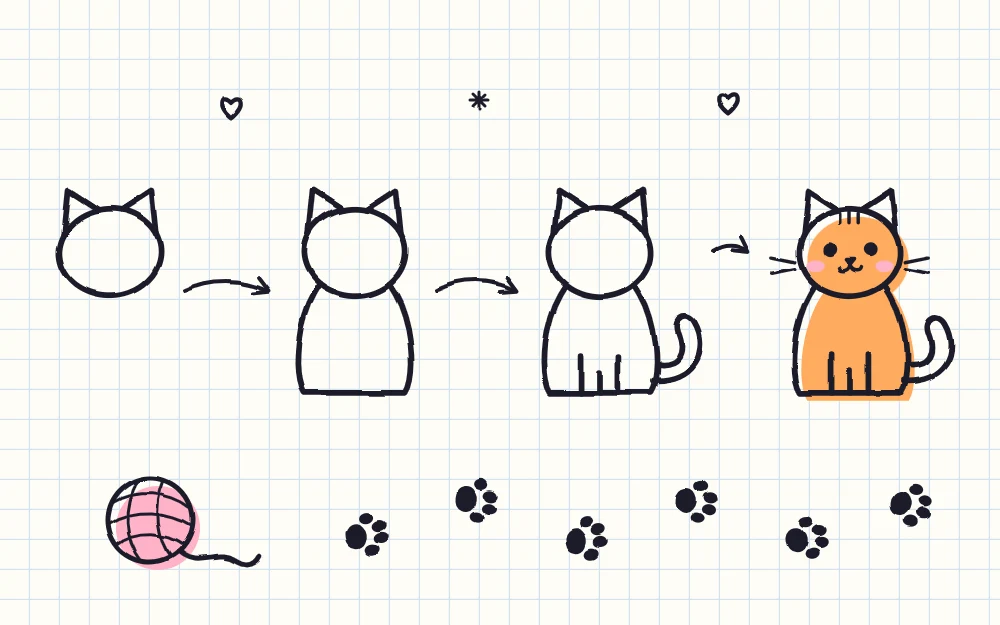
- Draw a round head, slightly wider than tall. Add two triangle ears on top, set well apart, each with one side blending into the curve of the head.
- Draw the body below the head: a rounded egg shape, narrow where it tucks under the chin and wider at the base. It should be a little taller than the head.
- Add the tail. Start at the bottom of the body on one side, sweep the line outward and curl the tip up, then draw a second line beside it to give the tail some thickness. For the front paws, draw two short upright lines in the lower middle of the body, each ending in a small bump.
- Finish the face. Place two dot eyes wide apart in the lower half of the head, a tiny upside-down triangle nose between them and a small W shape under it for the mouth. Flick three short whiskers out from each cheek.
Three More Cat Poses
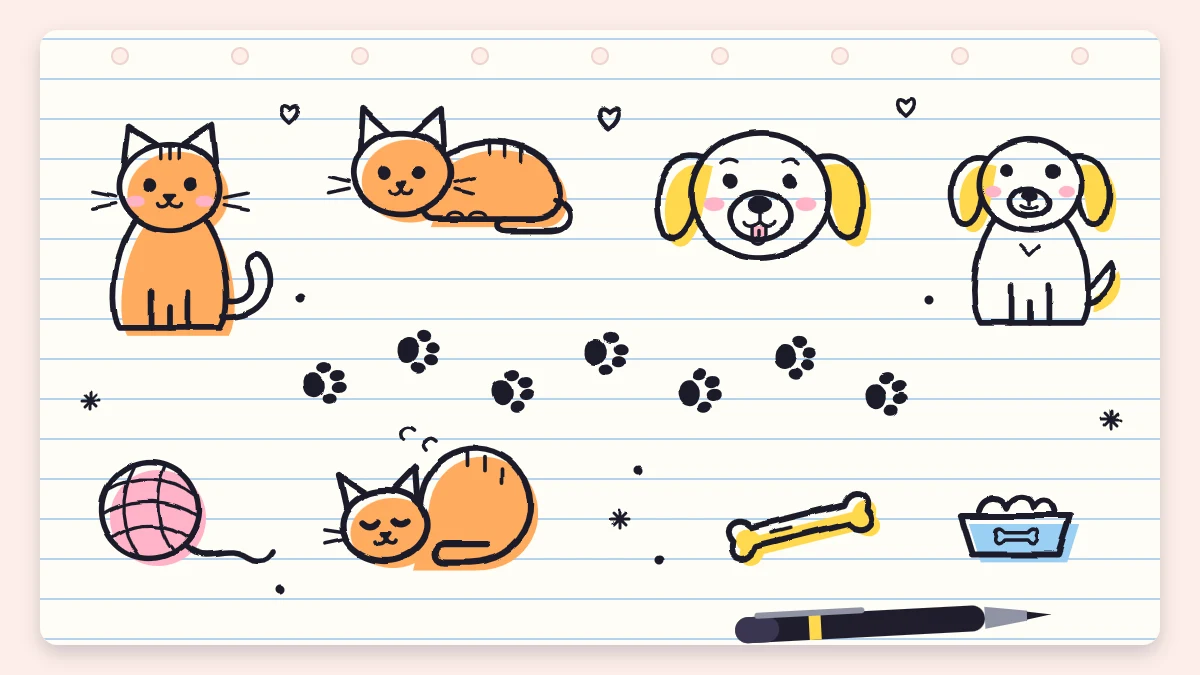
Cats fold themselves into simple shapes, which is handy for doodling.
- Loaf: draw a rounded rectangle, like a loaf of bread seen from the side. Draw the head overlapping one end, with ears and a face. Leave out the legs completely, and run one curved line along the base for a tail tucked against the body.
- Curled asleep: draw a circle. Inside it, at the lower left, draw a smaller round head with two ears. Curve a tail along the bottom edge of the circle until its tip reaches the nose. Use two short downward curves for closed eyes.
- Back view: draw a pear shape, with a small round head on a wider body. Add two triangle ears and no face at all. Let the tail hang from the base and curl to one side in a lazy S. Two or three short stripes across the back finish it.
A Dog Face in Four Stages
- Draw a rounded head, closer to a soft square than a circle, slightly wider at the bottom.
- Add two floppy ears. Each one is a long U that starts at a top corner of the head and hangs down the side, ending about level with the chin.
- Draw a wide oval muzzle low on the face. Put a rounded triangle nose at the top of the oval, then a short line straight down from it that ends in a shallow smile curve.
- Place two dot eyes just above the muzzle, wide apart. Add a tongue: a small U hanging from the middle of the smile, with a short line down its center.
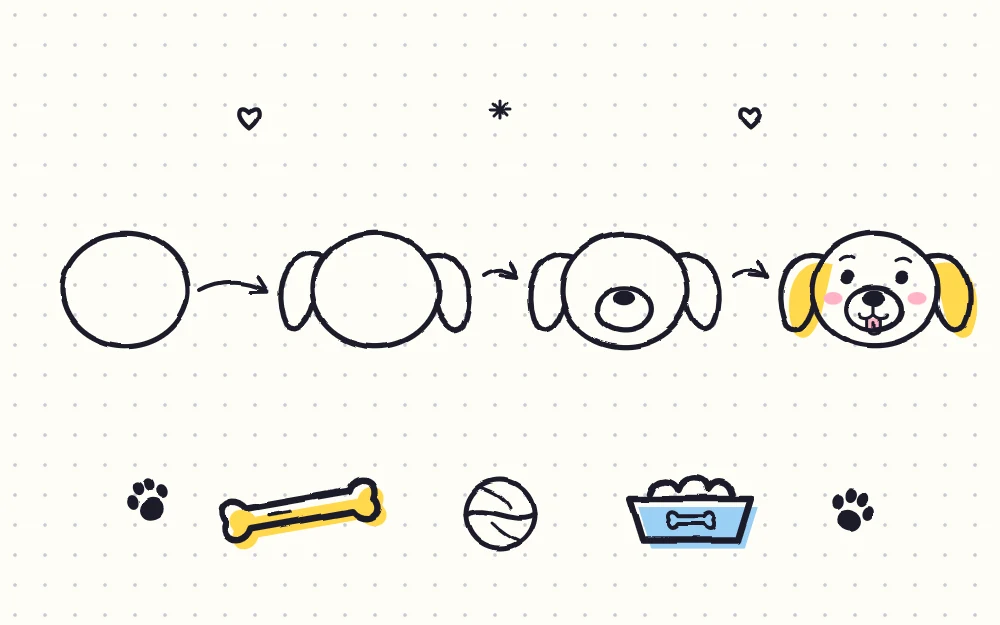
For a dog with pointed ears, swap the hanging U shapes for two wide triangles on top of the head, tilted slightly outward.
Two Full Dog Poses
- Sitting: draw the dog face, then an egg-shaped body beneath it, broader at the chest than the cat’s. Add two straight front legs running down the middle, each ending in a rounded paw. Draw a small oval at one side of the base for a back foot, and a short tail pointing up from the other side.
- Lying down: draw a long bean shape lying flat. Set the head at one end, resting low, with the ears flopping onto the ground. Stretch two front paws forward as narrow ovals under the chin, and add a short curved tail at the far end.
Tip
For a wagging tail, draw two or three small curved dashes on each side of it. For a happy cat, point the tail straight up with a tiny hook at the tip.
Make It Look Like Your Pet
One or two true details are enough.
- Ears: large or small, upright or folded, close together or wide apart. This changes the doodle more than anything else.
- Tail: thin, fluffy with a scalloped edge, a short stub or a tight curl.
- Markings: a patch around one eye, drawn as a loose circle. Stripes as short dashes on the forehead and back. Socks as a line across each paw. A pale chest as a curved bib.
- Collar: two curved lines under the chin with a small circle tag hanging from the middle.
Fill a marking with an accent color instead of solid ink, and the face stays easy to read. If the doodle looks stiff, the usual fix is rounder shapes and a lower face, both covered in the guide on how to make doodles cute.
Paw Prints, Bones and Other Extras
Small extras fill the space around a pet and work as filler between larger doodles.
- Paw print: draw one rounded triangle or bean for the pad, then four small ovals in an arc above it. Draw a few in a zigzag trail across the page.
- Bone: draw two short parallel lines, then close each end with two small bumps side by side, like the top of a heart.
- Ball of yarn: draw a circle. Cross it with three curved lines going one way and three going the other. Let one wavy line trail out from the bottom as the loose end.
- Food bowl: draw a trapezoid that is wider at the bottom than at the top. Add a row of small bumps along the top edge for the food, and a paw print or a simple stripe on the side.
To build a small scene, set the sitting cat beside the ball of yarn or the lying dog beside its bowl, then draw one flat line under both for the floor. An armchair, a lamp or a plant pot from the set of household object doodles gives your pet a room to sit in.
Frequently asked questions
What is the easiest way to doodle a cat?
Draw a round head with two triangle ears, then an egg-shaped body below it. Add a long curved tail, two dot eyes, a tiny triangle nose and three whiskers on each side. The ears, whiskers and tail carry the whole doodle, so the rest can stay very plain.
How do you make a dog doodle look different from a cat?
Change three things. Give the dog floppy or wider ears instead of small upright triangles, draw a rounder muzzle with a bigger nose, and shorten the tail. Leaving out whiskers and adding a small tongue also helps the face read as a dog right away.
How can a doodle look like a specific pet?
Choose one or two features that stand out on the real animal, such as a patch around one eye, a folded ear, a fluffy tail or white paws, and add only those. A simple doodle with one accurate detail is easier to recognize than a careful drawing with many.