Household Object Doodles: 20 Everyday Things to Draw
Twenty everyday objects from the desk, kitchen, living room and hallway, each reduced to one main shape and one telling detail, plus a table lamp drawn in four stages.

Doodle at a glance
What you need
- Black fineliner or gel pen
- Pencil and eraser for guide lines
- Any notebook page or sticky note
- One highlighter for an accent color
Stuck for something to draw? Look up. The lamp, the mug going cold beside you and the key on its hook are all waiting, and each one breaks down into a shape or two you already know. That is the whole idea behind household object doodles: take something ordinary, find its biggest shape, and add the one detail that gives it away.
Below are twenty everyday things sorted by room, each small enough for a sticky note and quick enough to finish in a minute or two. A flat, slightly wobbly outline is exactly the look.
Look for thirty seconds, then simplify
Pick an object you can see and study it for about thirty seconds before the pen moves. Ask two questions. What is the biggest shape? What single detail would tell a stranger what this is?
A kettle is a dome with a spout. A hanger is a triangle with a hook. Leave out reflections, screws and seams. Then look away and draw from memory, about the size of a coin, so only the parts that matter survive.
Tip
If a doodle does not read, do not add more lines. Make the giveaway detail bigger instead: a longer spout, a fatter handle, a wider shade.
Worked example: a table lamp in four stages
- Shade. Draw a short flat line for the top and a longer flat line below it, then join the ends with two slanted sides. That trapezoid is the lampshade.
- Stem. From the middle of the shade’s bottom edge, drop two close parallel lines straight down, about as long as the shade is tall.
- Base. Close the stem with a low dome: a flat line on the table and a shallow curve over it, wider than the stem and narrower than the shade.
- Light. Add three or four short dashes fanning out below the shade. The lamp is now switched on.
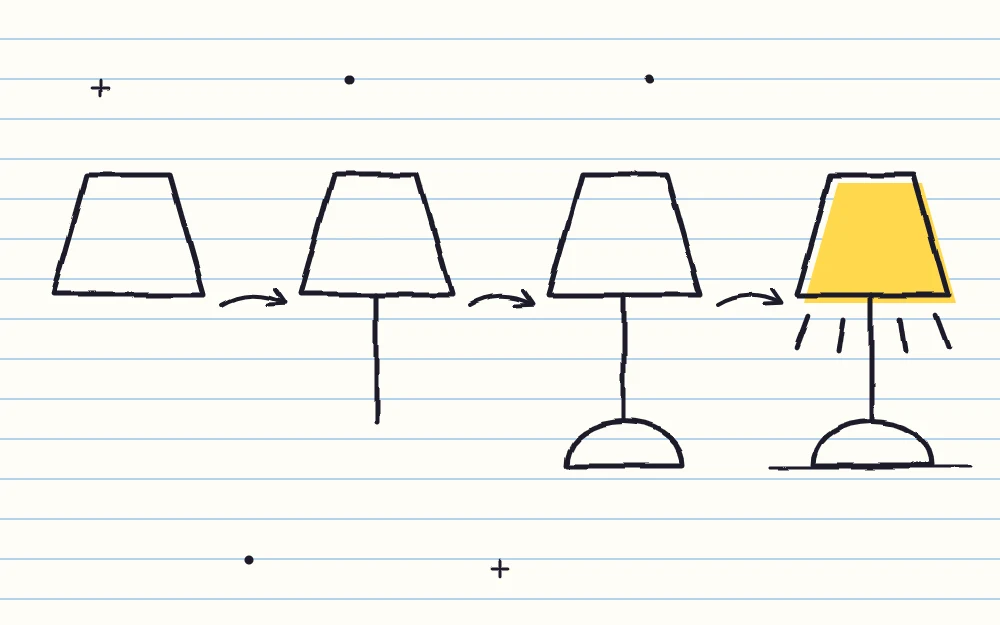
Every object below follows the same order: main shape, second shape, one detail.
On the desk
- Desk lamp. Draw the lamp above, but swap the straight stem for two lines that bend at an elbow.
- Stack of books. Draw three long, thin rectangles on top of each other, each shifted a little left or right. Add a short curved line inside one end of each for the pages. A single closed book is one upright rectangle with a narrow spine strip down its left side.
- Scissors. Draw a long, narrow X. Put a small oval loop on each of the two lower ends for the handles and a dot where the lines cross.
- Pencil cup. Draw a tall rectangle with a gently curved top edge. Poke three thin sticks out of the top at different heights and cap each with a tiny triangle.
- Glasses. Draw two circles side by side with a small gap, join them with a tiny arch, then add a short line slanting back from each outer edge.
In the kitchen
- Mug. Draw a rectangle with rounded bottom corners and hook a C-shaped handle onto one side. Steam, saucers and patterns are covered in the mug and teapot doodle guide.
- Kettle. Draw a flat baseline with a tall dome over it. Add a short spout like a bent finger on one side, an arched handle over the top and a small knob for the lid.
- Spoon. Draw an egg-shaped oval, then run two parallel lines from its narrow end and close them with a round tip. One small curve inside the oval suggests the bowl.
- Plant pot. Draw a trapezoid that is wider at the top and lay a thin rectangle across it as the rim. Two or three leaf shapes rising from the rim finish it, and the cactus and potted plant doodles give you more to grow in it.
- Candle holder. Draw a shallow saucer from a flat line with a curve under it. Stand a short rectangle in the center, add a small loop handle at one side of the saucer and a teardrop on top for the flame.
In the living room
- Armchair. Draw a rounded square for the backrest. Add a fat sausage-shaped arm on each side starting halfway down, a flat cushion line between them and two stubby feet.
- Clock. Draw a circle with a second circle just inside it. From a center dot, draw one short hand and one long hand. Skip the numbers; four tick marks are plenty. Two small domes on top and two little feet turn it into an alarm clock.
- Picture frame. Draw a rectangle with a smaller rectangle inside. Fill the middle with two overlapping triangles and a small circle for mountains and a sun.
- Light bulb. Draw a circle that stays open at the bottom, pinch the two ends inward and close them with a small square. Cross the square with two stripes and add a tiny loop inside the glass.
- Window. Draw a square and cross it with one vertical and one horizontal line. Add a sill line below that is slightly wider than the square, then a curved line sweeping from each top corner to the side for curtains.
By the front door
- Key. Draw a small circle with a smaller circle inside for the hole. Run two parallel lines out from it as the shaft and end with two or three square teeth on the lower edge.
- Umbrella. Draw a wide dome and replace its flat bottom with three or four scallops. Drop a straight line from the center down past the scallops and finish it with a J-shaped hook.
- Sock. Draw a thick L shape: a tube going down that turns into a rounded foot. Add a band across the top for the cuff and one curved line each at the heel and toe.
- Hanger. Draw a wide, flat triangle. From the top point, take a short line up and curl it over like a question mark.
- Door. Draw a tall rectangle with two smaller rectangles inside, one above the other. Place a dot for the knob halfway down one side and a short line under the door for the mat.

Turn single objects into a set
Five objects from the same room, drawn the same size with the same pen, look like a collection. Draw a long flat line as a shelf and stand the lamp, the books, the plant pot and the clock along it, a finger width apart.
For a set tidy enough for planner pages, use the framing trick from the guide to drawing simple line icons: every object gets the same small pencil square to fit inside.
One accent color goes a long way. Run a highlighter over the lampshade, the mug and the sock cuff, and leave the rest as plain line.
Watch out
Gel and felt-tip ink can smudge until it dries. Give the outline a moment before adding highlighter.
Frequently asked questions
What household objects are easiest to doodle?
Start with objects that are close to one flat shape: a mug, a key, a picture frame, a door or a hanger. Each needs a single outline and one added detail. Leave the armchair and the kettle until those feel comfortable, because they combine three or four shapes.
Do I need to draw objects with depth to make them recognizable?
No. A flat front or side view is enough for a small doodle. Choose the view where the object has its most familiar outline, such as a mug from the side or a clock from the front, and let one clear detail do the rest.
How small should object doodles be?
Roughly the size of a coin works well. At that size there is no room for fussy detail, so the drawing stays simple, and a whole row of objects fits along a margin or the top of a page.