How to Doodle: A Relaxed Guide for Complete Beginners
A doodle is just a few basic shapes plus one or two details. Here is the idea behind every small drawing, a first five-minute session to try and where to go next.
If you have ever said “I can’t draw,” you are exactly who doodling is for. Learning how to doodle has very little to do with talent and a lot to do with keeping things small, quick and simple enough that nothing can really go wrong.
A doodle is a small, casual drawing, usually made with a pen in a margin or on a scrap of paper. There is no shading, no perspective and nobody grading it. Below you will find the one idea behind nearly every doodle, a first five-minute session to try, and pointers to the guides that go deeper.
What Counts as a Doodle
People who fill pages with tiny drawings are not doing anything complicated. They are following a few quiet rules, usually without thinking about them:
- Small. Most doodles are about the size of a coin, so a single page holds dozens of them.
- Quick. One doodle takes a few seconds to a minute or two. If it takes much longer, it has turned into a drawing.
- Flat. You draw the outline and one or two inside lines. No shadows, no depth, no realistic proportions.
- Low-pressure. A lopsided star is still a star. Slightly wobbly lines are part of the look.
That is the whole definition. A heart in the corner of a shopping list counts. So does a row of triangles along the top of a page.
The One Idea: Basic Shapes Plus a Detail
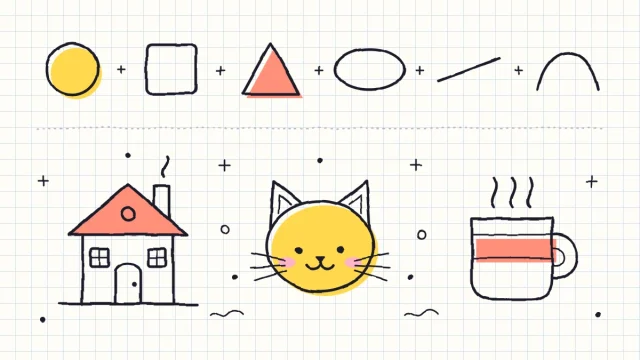
Look closely at any doodle and it comes apart into pieces you already know how to make: circles, boxes, triangles, straight lines and curves. What turns those pieces into “a flower” or “a mug” is one or two small details added at the end.
Try it with a flower:
- Draw a small circle, about the size of a pea. This is the center.
- Add five petals around it. Each petal is a U-shaped loop that starts on the circle and comes back to it. Put the first one at the top, then work your way around.
- Pull one slightly curved line down from the bottom of the flower for the stem.
- Add a leaf on each side of the stem: two short curves that leave the stem together and meet in a point.
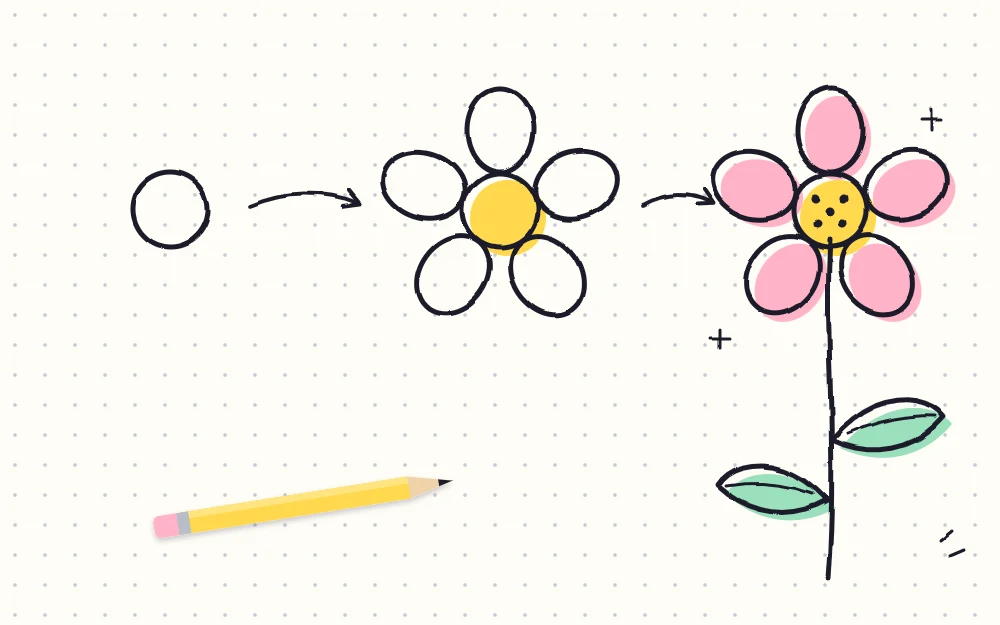
None of those strokes is hard on its own. A mug works the same way: a box with rounded bottom corners, a C-shaped handle on the right side, and two wavy lines rising from the top for steam. Without the steam it could be a bucket. The detail is what makes it read as a hot drink.
Once you start seeing objects this way, you can break down almost anything on your desk. The guide to building doodles from basic shapes walks through the method with more worked examples.
Your First Five-Minute Session
You need a pen, any piece of paper and about five minutes. The goal is not one good drawing. It is six small ones.
- Pick one object. Choose something simple that you can see or picture easily. The mug described above is a good first choice.
- Draw it small. Keep it about as tall as a coin. Outline first, then the handle, then the steam.
- Repeat it five times. Draw five more in a row, leaving a little space between them.
- Change one thing each time. Make the second mug taller and narrower. Give the third two stripes around the middle. Put a tiny heart on the side of the fourth. Set the fifth on a saucer, which is just a flat oval underneath. Give the last one two dot eyes and a small curved smile.
- Stop and look at the row. The last mug will almost certainly look more relaxed than the first.
Somewhere around the third or fourth mug, your hand stops hesitating because it already knows the shape. From there you are no longer working out how to draw the thing. You are playing with it, and changing one thing at a time is exactly how people who doodle a lot come up with new ideas.
Why Small and Why Pen
Drawing small hides a lot. A wobble that would stand out in a line running across a whole page disappears in a line the length of a fingernail. Small doodles also finish fast, so one that goes wrong has cost you ten seconds and a corner of the page.
Pen helps for a less obvious reason. With a pencil, it is tempting to erase and redraw the same curve until the paper turns gray. A pen removes that option. The line is down, so you move on to the next doodle, and moving on is where the practice happens.
Any pen will do to begin with, including the ballpoint by the phone. When you get curious about thinner tips, smudging and which notebook to use, the guide to doodle pens and paper covers the options by type.
Tip
When a line goes somewhere you did not plan, keep it. Thicken it, repeat the wobble on the other side so it looks deliberate, or turn the shape into something else. A crooked circle makes a fine potato, pebble or cloud.
Three Common Worries
“My lines are shaky”
Draw shorter lines, and draw them a little faster. One quick stroke comes out smoother than a slow, careful one. A slight wobble also suits the style, so there is no need to chase ruler-straight edges.
“My shapes come out lopsided”
They will, and it does not matter. Draw the same heart ten times in a row and no two will match. Together they look like a pattern, not like ten mistakes.
“I never know what to draw”
This is the most common sticking point, and it has nothing to do with skill. Start with the nearest object and draw only its outline. If the desk is empty, borrow a prompt from this list of quick things to doodle when you are bored.
Where to Go Next
After the mug session, try a wider mix of subjects. The collection of easy doodles for beginners lists 25 simple things, each with a one-line description of how to draw it, sorted by the shape it starts from.
From there, pick a theme you like, such as leaves, weather or snacks, and fill half a page with it. Keep a pen wherever you usually sit and let the margins fill up a little at a time. Nothing has to be finished, and nothing has to be shown to anyone.
Frequently asked questions
Can I learn to doodle if I can't draw?
Yes. Doodles are small, flat outlines built from circles, boxes, triangles and lines, so they do not call for the skills that realistic drawing does. If you can write your name, you can already make every stroke a doodle needs. The rest is repeating simple objects until your hand knows them.
What should I doodle first?
Pick one plain object with a clear outline, such as a mug, a cloud or a leaf, and draw it about the size of a coin. Then repeat it five times and change one thing on each copy. A single object drawn six ways is a better start than six different subjects.
Should I doodle in pen or pencil?
Pen is the better habit for doodling. Because you cannot erase, you stop fussing over one line and move on to the next small drawing, which is where the practice comes from. Keep a pencil for light guide lines on bigger layouts such as borders, and use pen for everything else.