Star and Moon Doodles: Easy Night Sky Ideas
Five ways to draw a star, a crescent from two curves, a full moon with craters, a row of moon phases, a ringed planet, a shooting star and simple constellations, then a night-sky corner to put them in.

Doodle at a glance
What you need
- Black fineliner or gel pen
- Pencil and eraser for guide dots
- Yellow highlighter for an accent color
- Any notebook page
A night sky is the easiest scene to doodle, because it is mostly empty. One moon, a handful of stars and a lot of dots are enough, and there is no ground, horizon or correct arrangement to worry about. Star and moon doodles also shrink well, which makes them handy for margins and for the gaps between other drawings.
Here are five ways to draw a star, a crescent and a full moon, plus a few extras: a ringed planet, a shooting star, a constellation and a sleepy cloud. The last section puts them together as a night-sky corner.
The five-point star in one continuous line
This is the classic star, drawn without lifting the pen. Five dots make it come out even.
- Five dots. Lightly mark five dots in a ring: one at the top, one out to each side a little above the middle, and two at the bottom, set slightly in from the sides.
- First two strokes. Start at the bottom left dot. Draw a straight line up to the top dot, then straight down to the bottom right dot.
- Finish the line. Without lifting the pen, go to the left side dot, straight across to the right side dot, and back down to where you started.
- Outline only. For a cleaner star, do steps one to three in pencil. Ink just the outer edge, ten short strokes going out to a point and back in, and erase the crossing lines inside. Add a dab of yellow if you like.
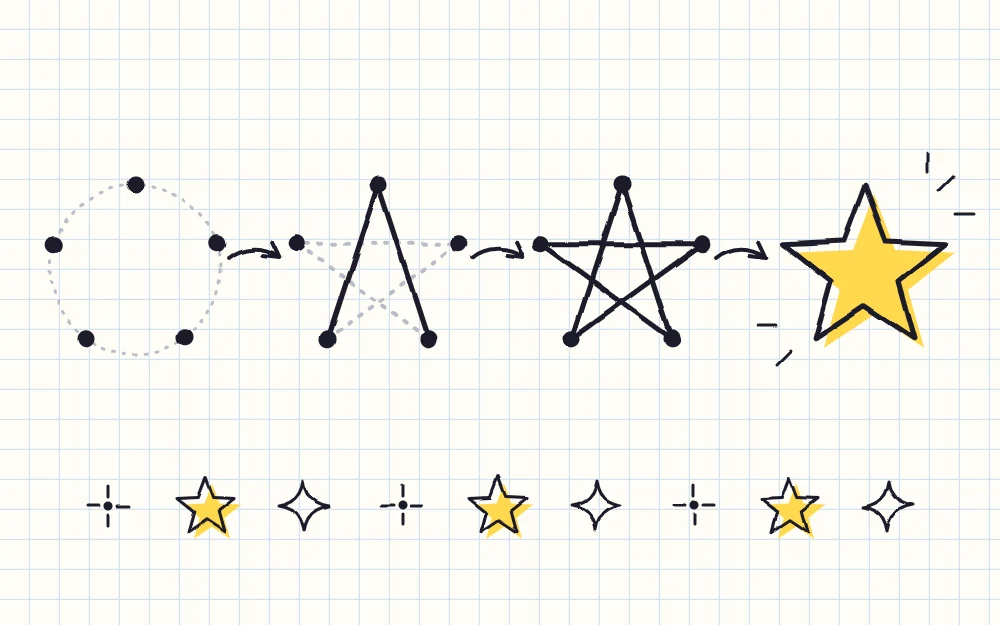
That gives you two stars already: the crossed one-line version and the open outline.
Three quicker stars
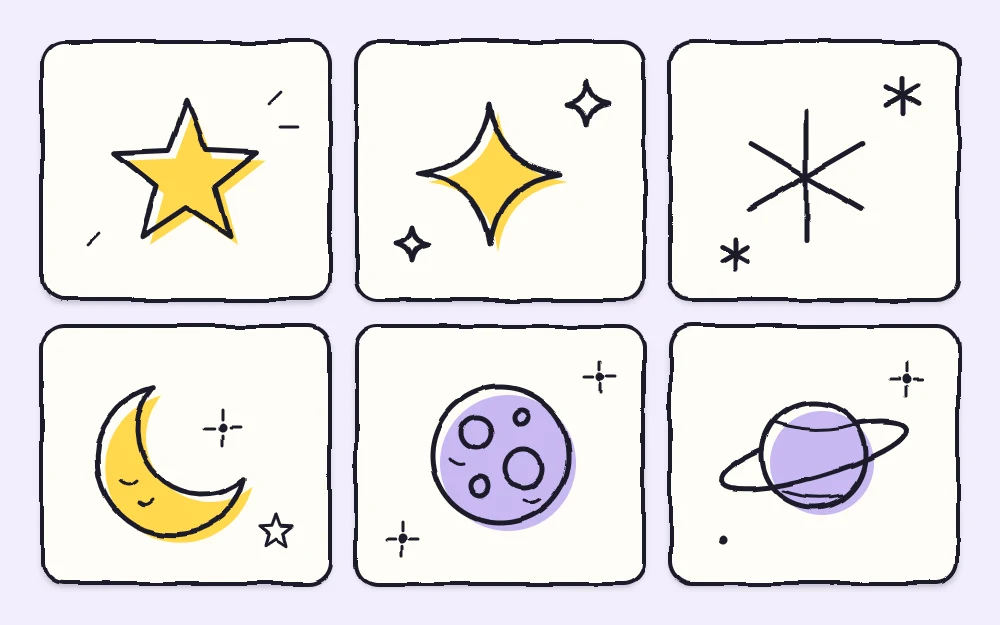
- Four-point sparkle. Draw a small plus sign as a guide. Join the tip of each arm to the next with a curve that bows inward toward the center, so you get four sharp points with pinched sides. Make the vertical points longer than the sideways ones.
- Asterisk star. Draw a short vertical line, then cross it with two slanted lines through the same center. Six arms, three strokes.
- Dot-and-cross twinkle. Draw a dot. Add four tiny dashes around it, above, below, left and right, without touching the dot. This is the smallest star of the five and the one you will use most.
Tip
Tilt your stars. A five-point star leaning slightly to one side looks more relaxed than one standing perfectly upright, and a tilted group reads as a scatter.
Crescent and full moon
Crescent from two curves
Draw a wide C shape, like the left edge of a circle. From its top tip, draw a second curve that bends the same way but stays shallower, and bring it down to meet the bottom tip. The space between the two curves is the moon. A deeper inner curve gives a thin sliver; a shallow one gives a fat crescent.
Full moon with craters
Draw a circle. Inside it, add three or four craters in different sizes: small circles and a couple of open C shapes, grouped off center. Keep them away from the edge, and leave about half the moon blank.
Moon phases as a row
Draw five circles of the same size in a line. Leave the middle one empty as the full moon. In the circles on either side of it, fill in a thin sliver on the outer edge. In the two end circles, fill everything except a thin crescent on the side facing the middle. The row reads as a moon growing and shrinking, and it makes a neat header for a page.
Planet, shooting star and sleepy cloud
- Ringed planet. Draw a circle. Add a long, flat oval tilted across its middle, wider than the circle on both sides. Erase or skip the part of the oval that passes behind the planet, and put two curved stripes on the planet itself.
- Shooting star. Draw a small five-point star or a sparkle. From its lower side, pull three straight lines away in the same direction, the middle one longest. End each line with a dot or two.
- Sleepy cloud. Draw a flat base and three bumps above it, closing the shape. Low on the cloud, add two short downward curves for closed eyes and a tiny curve for a mouth. The clouds in the weather doodles guide use the same outline without the face.
Simple constellations from dots and lines
A constellation doodle is just dots joined by thin straight lines. Place five to seven dots in a loose, uneven shape, then connect them in one path without crossing your own line. Make one or two dots larger, or swap them for twinkles.
For a familiar shape, try a dipper: four dots as the corners of a slightly crooked box, then three more trailing away from one top corner in a gentle bend, like a handle. Join the box, then the handle.
Inventing your own is half the fun. Draw the dots first, then decide what the shape looks like.
Compose a night-sky corner: big, medium, tiny
A sky looks right when its pieces come in three clear sizes. Work in this order.
- One big thing. Draw a crescent or full moon near the corner of the page, about the size of a coin.
- Three to five medium things. Add a few five-point stars or sparkles around it at uneven distances, plus one planet or shooting star.
- Lots of tiny things. Fill the gaps with twinkles and plain dots as filler, more of them near the moon and fewer as you move away.
Let the scatter thin out toward the writing area so the corner fades into the page. For other ways to decorate around your notes, see the notebook doodle ideas.
Watch out
Filled moons and solid dots hold a lot of ink. Gel and felt-tip ink can smudge until dry, so start at the far side of the corner and work toward your hand.
If you would like stars across a whole page or a notebook cover, the same three sizes apply on a larger scale. The guide to repeating doodle patterns shows how to space them so the page fills evenly.
Frequently asked questions
How do you draw a five-point star without lifting the pen?
Mark five dots in a ring: top, two sides and two at the bottom. Start at the bottom left, go up to the top, down to the bottom right, across to the left side, straight over to the right side, and back to the start. Five straight strokes make the star.
What is the easiest way to doodle a crescent moon?
Draw a wide C shape, then a second, shallower curve from the top tip to the bottom tip on the inside of the first. The gap between the two curves is the crescent. Changing how deep the inner curve goes makes the moon thinner or fatter.
How do I make a night-sky doodle look balanced?
Use three sizes. Place one large moon first, add a few medium stars around it at uneven distances, then fill the gaps with tiny twinkles and dots. Put more dots near the moon and fewer farther away so the scene fades out.